Shipping Small, Powerful Tools 10x Faster in the Age of AI

Mar 14, 2026
Shipping Small, Powerful Tools 10x Faster in the Age of AI
Spider Graph Generator
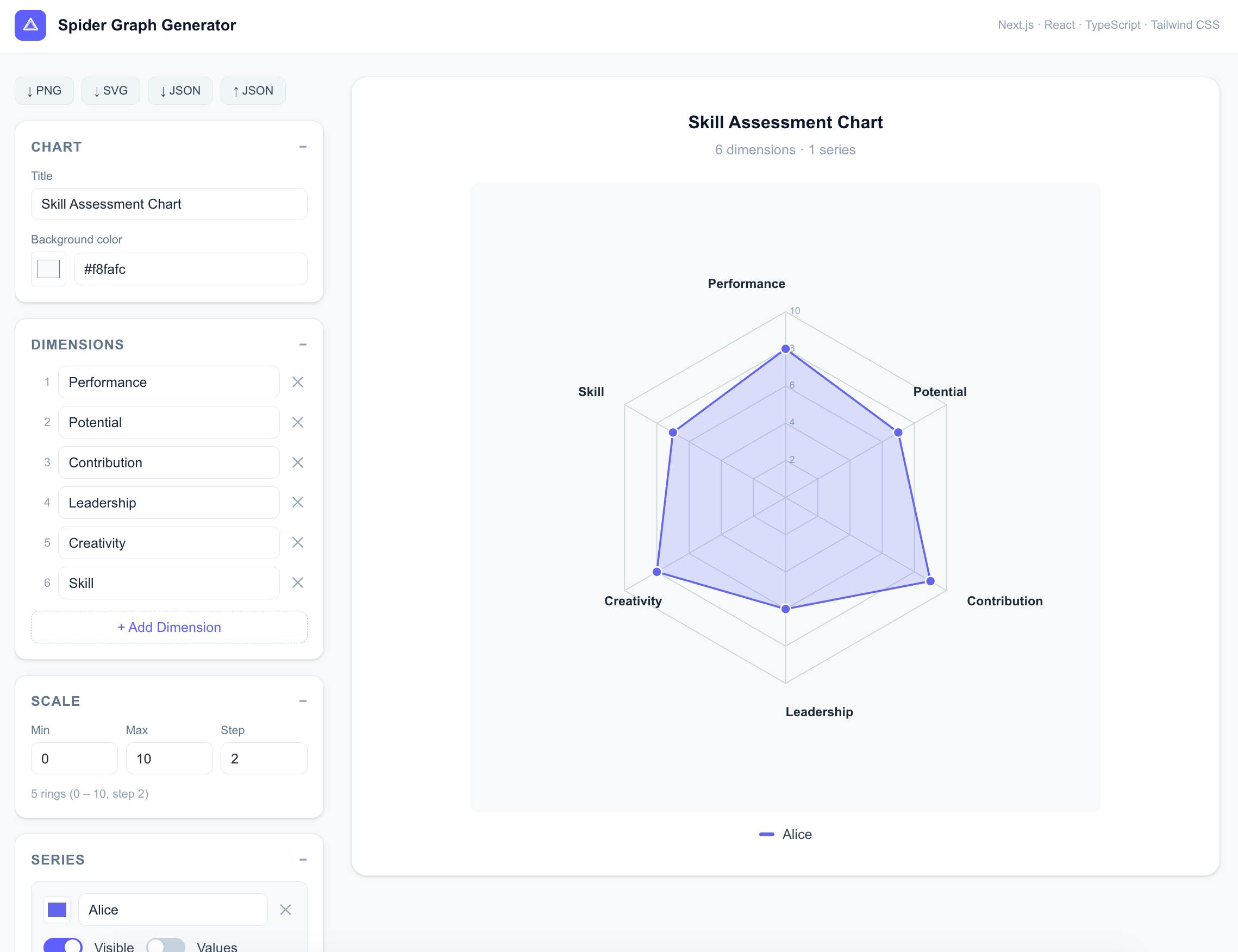
A look at Spider, a lightweight spider graph generator built for speed, scale, and AI-native workflows
There has never been a better time to be a software engineer.
With tools like GitHub Copilot, Claude Code, and Antigravity, the ceiling on individual productivity has changed dramatically. A focused engineer with the right tools can now design, prototype, build, test, and ship production-ready utilities at a pace that would have required an entire team just a few years ago.
That reality is exactly what made Spider possible.
You can explore the project here: https://github.com/rmontero/spider
Spider is a small but powerful tool designed to generate spider graphs (radar charts) dynamically and at scale. While the visualization itself is simple, the philosophy behind the tool is very intentional. The goal was not to build another charting library. https://spider.robs.ws/
The goal was to build a fast, programmable engine that can generate spider graphs from structured data, and expose that capability to both humans and AI systems. Because increasingly, the users of software are not just people. They are agents.
Why Spider Exists
- Spider graphs are one of the most effective ways to visualize multidimensional comparisons.
- They are commonly used to represent:
- Skills matrices
- Capability comparisons
- Engineering competency frameworks
- Product feature scoring
- Vendor evaluations
- AI model benchmarking
- Talent matching profiles
Despite their usefulness, generating spider graphs at scale is surprisingly painful. Most existing tools assume manual interaction, spreadsheets, or heavyweight visualization libraries.
Spider takes a different approach.
Instead of focusing on UI first, it focuses on data generation and automation.
The core idea is simple:
If a graph can be defined as data, it should be generated programmatically.
That means Spider is built around structured inputs, not manual drawing.
You define:
- Dimensions
- Scale
- Values
- Labels
- Display toggles
The tool then generates the visualization dynamically.
Even more importantly, Spider exposes that functionality through an API and MCP interface, which means the graphs can be generated automatically by scripts, pipelines, or AI agents.
Built for Speed and Scale
Spider was intentionally designed to be small, fast, and composable. Instead of building a heavy framework, the tool focuses on a few core capabilities:
- Dynamic dimension generation
- Concentric polygon rendering
- Multi-line graph overlays
- Toggleable labels and values
- Structured input schemas
- Programmatic generation
The geometry is deterministic. From the center, the tool draws concentric polygons representing the scale, and overlays one or more datasets as lines across those axes. This approach makes the graph data first and machine friendly, which becomes incredibly useful when you need to generate thousands of these visualizations.
Designed for Agents as Much as Humans
One of the more interesting aspects of Spider is that it is intentionally AI native. The tool exposes both:
- An API *
- An MCP interface * (* private beta only for now)
This means it can be used by:
- humans generating graphs
- automation pipelines
- data platforms
- AI agents
Imagine an AI system evaluating candidates against a skills framework.
Instead of returning a table of scores, the system could generate a spider graph for each candidate, instantly visualizing strengths and gaps.
Or imagine:
- benchmarking AI models
- comparing engineering teams
- mapping product capabilities
Spider turns those comparisons into visual artifacts automatically.
This becomes especially powerful when integrated into workflows driven by LLM agents.
The New Reality of Engineering Productivity
Tools like Spider highlight a larger shift happening in software development.
We are entering an era where the best engineer is no longer limited by typing speed or manual coding effort.
With the right AI tooling, engineers can operate at a completely different level of leverage. Tools like:
- GitHub Copilot
- Claude Code
- Antigravity
act less like autocomplete tools and more like force multipliers.
A strong engineer can now:
- architect systems faster
- generate scaffolding instantly
- iterate rapidly
- test ideas in minutes instead of days
The result is something remarkable. A single engineer can now build small, focused tools that would have previously required weeks of work. Spider is a good example of that shift. What once would have been a side project spanning multiple sprints can now be designed and shipped in a fraction of the time, while still being production-ready and extensible.
Small Tools, Big Impact
Some of the most useful software in the world is not large platforms. It is small, focused utilities that solve a specific problem extremely well. Spider fits squarely in that category. It does one thing. It generates spider graphs quickly, programmatically, and at scale. But when you combine that with modern AI workflows, the impact becomes much larger.
You start to unlock:
- automated skill analysis
- talent matching visualizations
- model evaluation dashboards
- capability benchmarking
- large scale comparative analytics
All driven by simple structured data.